Physical Address
304 North Cardinal St.
Dorchester Center, MA 02124
Physical Address
304 North Cardinal St.
Dorchester Center, MA 02124
Improving at chess requires more than just knowing the rules; it demands strategic thinking and the ability to avoid common pitfalls. Intermediate players often find themselves stuck, unable to break through to the next level due to recurring mistakes.
Recognizing and correcting these errors is crucial for enhancing one’s chess game. By understanding where they go wrong, players can refine their strategies and make more informed decisions during play.
As chess players progress from beginners to intermediate levels, they often encounter a plateau that hinders further improvement. This stagnation can be frustrating, especially when it seems like progress has come to a halt despite consistent practice. Understanding the reasons behind this plateau is crucial for breaking through to the next level.
The journey from being a beginner to an advanced chess player involves significant skill development. Beginners focus on basic tactics and understanding how the chess pieces move. As players advance, the game becomes more complex, involving deeper strategic thinking and a more nuanced understanding of the game. The gap between intermediate and advanced players often lies in the ability to apply strategic concepts effectively. Advanced players have a more refined understanding of positional play, pawn structure, and endgame techniques.
According to grandmaster
“The key to success lies not in knowing more, but in understanding the strategic depth of the game.”
This emphasizes the importance of moving beyond mere memorization of moves and focusing on the strategic aspects of the game.
The transition from intermediate to advanced levels is a critical phase in a chess player’s development. It requires a shift from tactical exercises to a more strategic understanding of the game. Players must learn to analyze positions more deeply, understand complex middlegame strategies, and master basic endgames. This phase is challenging because it demands a qualitative change in how players think about the game.
To navigate this transition successfully, players should focus on improving their understanding of strategic concepts and practicing endgames. As “The beauty of chess is that it is not just a game, but a reflection of life’s complexities.” Mastering chess involves embracing its complexities and continually adapting one’s strategy.
Recognizing patterns and breaking bad habits are key psychological aspects that can elevate a player’s online chess game. Improving at chess involves more than just knowing the chess rules; it requires understanding the mental processes behind decision-making.
Pattern recognition is a critical skill in chess, allowing players to quickly identify familiar structures and respond accordingly. By studying famous games and common tactics, players can enhance their ability to recognize patterns, thereby improving their reaction time and decision-making during online chess games.
Effective pattern recognition can be developed through consistent practice and review of various chess scenarios, helping players to anticipate and counter their opponents’ moves more effectively.
| Pattern Type | Description | Benefit |
|---|---|---|
| Tactical Patterns | Recognizing common tactics like pins and forks | Improved tactical awareness |
| Strategic Patterns | Understanding pawn structures and piece placement | Enhanced strategic planning |
Breaking bad habits is equally important as developing good ones. Players must identify and challenge their own thought processes and behaviors during games. For instance, consistently moving the same piece multiple times without a clear strategy can be detrimental. By becoming aware of such habits, players can work on replacing them with more effective strategies.
Building good habits involves consistent practice and a focus on chess rules and strategies. Players should aim to develop a disciplined approach to the game, combining knowledge of chess rules with strategic thinking.
One of the most critical errors intermediate chess players make is neglecting fundamental opening principles. The opening sets the stage for the entire game, influencing both chess strategy and chess tactics. A well-played opening can provide a significant advantage, while a poorly played one can lead to a difficult position.
Moving the same pieces multiple times in the early stages of the game is a common mistake. This error wastes valuable tempo that could be used to develop other pieces. For instance, repeatedly moving a knight while other pieces remain undeveloped can lead to a lag in chess development. Instead, focus on developing all your pieces harmoniously.
Another mistake is prioritizing attacks over development. While launching an early attack might seem aggressive, it often backfires if your pieces aren’t properly developed. A premature attack can be easily repelled, leaving your attacking pieces vulnerable. It’s crucial to develop your pieces before launching a significant attack.
Building a practical opening repertoire involves understanding key principles rather than memorizing moves. Start by learning the basic opening principles, such as controlling the center and developing your pieces efficiently. Then, choose a few openings that fit your style and study them deeply.
Effective opening study involves more than just memorizing lines. Analyze master games, focusing on how the opening principles are applied. Use tools like databases to explore different variations and understand the strategic and tactical ideas behind them.
Knowing when to deviate from established opening theory is a valuable skill. If your opponent is well-prepared, following the main line might lead to a draw or worse. Look for opportunities to deviate with a move that challenges your opponent’s preparation and fits the position’s requirements.
One of the most significant challenges intermediate chess players face is missing tactical opportunities that could turn the game in their favor. Tactics are the tactical maneuvers that can drastically change the outcome of a game, often catching opponents off guard. Understanding and executing these tactics is crucial for players looking to improve.
Intermediate players often miss winning combinations due to a lack of experience in recognizing tactical patterns. This can be attributed to insufficient practice in analyzing games and positions critically. To overcome this, players must hone their ability to spot potential tactics by studying master games and practicing tactical puzzles.
Certain tactical patterns are frequently overlooked by intermediate players, including pins, forks, and skewers. These tactics can lead to significant material gains or checkmate opportunities. Familiarizing oneself with these patterns through dedicated study can greatly enhance a player’s tactical vision.
Developing tactical vision requires consistent practice and a deep understanding of various tactical motifs. Players can improve by engaging in daily tactical training routines and using computer analysis to review their games and identify missed tactics.
Engaging in daily tactical training can significantly enhance a player’s ability to spot tactical opportunities. This can involve solving tactical puzzles, analyzing master games, and practicing specific tactics like pins and forks.
Computer analysis is a powerful tool for identifying missed tactics in games. By reviewing games with chess engines, players can uncover tactical opportunities they missed and understand how to implement them in future games.
One of the most significant challenges intermediate chess players face is managing their time efficiently during games. Effective time management is essential to make thoughtful decisions and avoid blunders under time pressure.
Time pressure can significantly affect a player’s psychological state, leading to increased stress and anxiety. This pressure can cause players to make impulsive decisions, often resulting in mistakes that could have been avoided with more time to think.
As Grandmaster John Nunn once said, “Time trouble is a common affliction in chess, and it can be a major obstacle to success.” Managing time effectively helps in maintaining a calm and focused mindset throughout the game.
Finding the right balance between deep calculation and intuition is crucial in chess. While deep calculation can provide a thorough analysis of positions, intuition helps in making quick decisions based on experience and pattern recognition.
A good chess player knows when to rely on intuition and when to engage in deep calculation. This balance is key to managing time effectively and making the most of the time available.
Developing a time management strategy is vital for chess players. This involves allocating time for different phases of the game, such as the opening, middlegame, and endgame.
Different game formats, such as blitz, rapid, or classical chess, require different time management strategies. Understanding the specific time controls and adjusting the strategy accordingly is crucial for success.
Identifying critical positions and investing extra time to analyze them can significantly impact the game’s outcome. Players should learn to recognize when a position requires deeper analysis and allocate their time accordingly.
By adopting these strategies, chess players can improve their time management skills, leading to better performance and more enjoyable games.
One of the most critical mistakes intermediate chess players make is underestimating the power of pawn structure. The arrangement of pawns on the board can significantly influence the game’s outcome, as it affects piece mobility, controls key squares, and dictates potential pawn breaks.
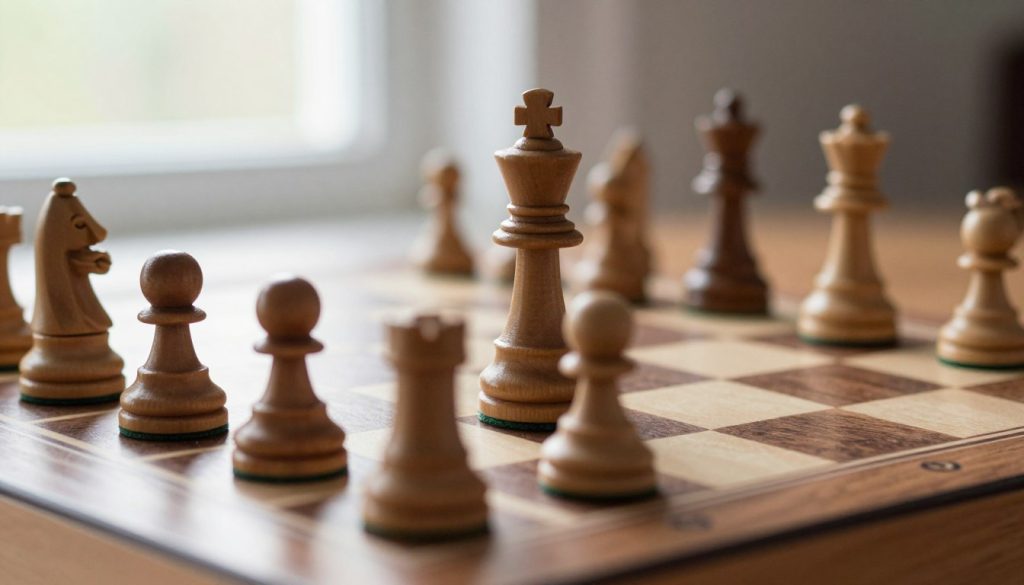
Pawn structure plays a crucial role in shaping middlegame plans. The pawns can either support or hinder the movement of pieces. For instance, pawns that are positioned in the center of the board can control key squares and limit the opponent’s piece mobility.
Several common weaknesses in pawn structure can be exploited by opponents. These include:
Understanding pawn structure can help guide your overall strategy. By identifying the strengths and weaknesses of your pawn structure, you can make informed decisions about piece development and potential pawn breaks.
Weak squares in your pawn structure can be exploited by your opponent. Identifying these squares and taking steps to mitigate their weakness is crucial. This can involve placing pieces on these squares to control them or creating pawn breaks to challenge your opponent’s control.
Pawn levers are pawns that are positioned to potentially capture an opponent’s pawn, creating tension and potential weaknesses. Creating and utilizing pawn levers effectively can help you gain a strategic advantage.
One of the most critical phases of a chess game is the endgame, yet many intermediate players struggle with it due to insufficient knowledge. The endgame is where chess strategy and skill truly come into play, converting advantages into wins.
To improve their endgame play, intermediate players should focus on mastering key principles. These include understanding opposition, zugzwang, and the importance of king activity. Knowing how to use pawns effectively and create passed pawns can significantly enhance a player’s chances of winning.
Converting advantages into wins is a hallmark of a skilled chess player. This involves not just understanding basic endgame principles but also being able to apply them effectively. Techniques such as triangulation and creating passed pawns are crucial. Players should practice these techniques to become proficient.
Studying master games and practicing endgames are essential for improvement. Players can benefit from analyzing famous endgames and attempting to solve endgame puzzles. Focusing on must-know theoretical positions and practicing endgame calculation techniques can significantly enhance a player’s skills.
Theoretical positions such as the Lucena and Philidor are fundamental. Understanding these positions can help players convert advantages into wins. Studying these and other key positions can provide a significant edge.
Endgame calculation involves visualizing the board and predicting outcomes. Techniques such as counting moves to promote pawns and understanding the opposition can be critical. Regular practice improves these skills.
One of the most significant mistakes intermediate chess players make is failing to properly analyze their games. Self-analysis is crucial for identifying mistakes and understanding how to improve. Without it, players can’t learn from their errors, leading to stagnation and frustration.
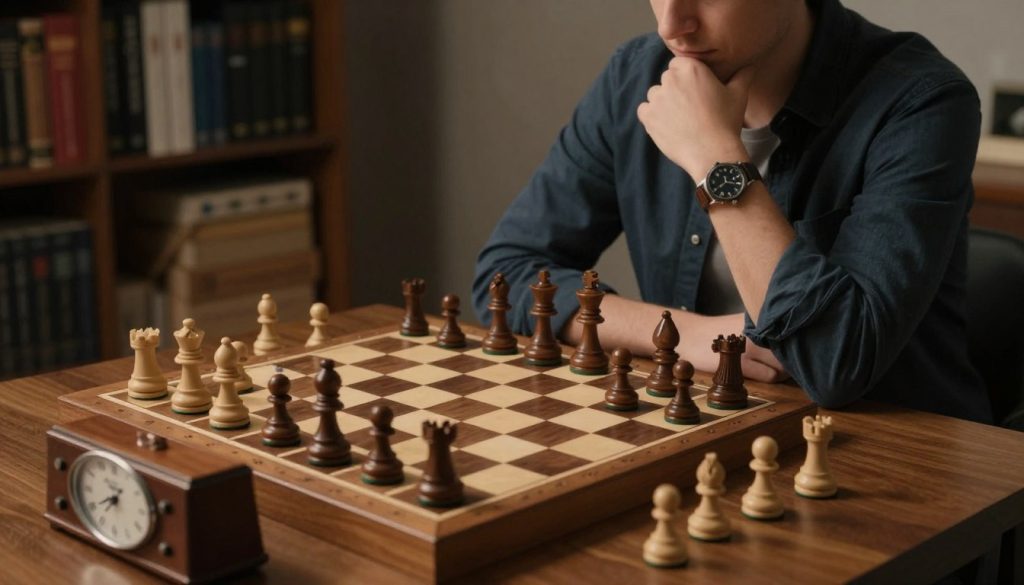
Objective post-game analysis allows players to review their decisions and understand the consequences of their actions. This process helps in identifying patterns and mistakes that can be corrected in future games. By analyzing games objectively, players can improve their understanding of chess tactics and strategies.
Players often fall into the trap of biased analysis, where they justify their moves rather than critically evaluating them. To overcome this, it’s essential to adopt a neutral perspective and consider alternative moves. Using chess engines can help provide an unbiased view of the game.
Creating a consistent analysis routine is vital for improvement. This involves setting aside time to review games, using tools like chess engines, and studying master games in similar positions.
Chess engines can significantly enhance analysis by providing insights into optimal moves and highlighting mistakes. To use them effectively, players should compare their moves with the engine’s suggestions and understand the reasoning behind the recommended moves.
Studying master games can offer valuable lessons, especially when focusing on positions similar to those encountered in one’s own games. This helps in understanding how masters handle various situations, improving overall strategic understanding.
One of the most critical errors intermediate chess players make is neglecting strategic planning, which can significantly impact their game outcomes. Strategic planning involves setting long-term goals and adjusting tactics accordingly, a skill that distinguishes advanced players from intermediate ones.
Understanding the difference between tactics and strategy is fundamental to improving at chess. Tactics involve short-term maneuvers, such as pins, forks, and skewers, aimed at gaining a material advantage. Strategy, on the other hand, encompasses the overall plan, guiding the player’s decisions throughout the game. A good strategist knows how to balance tactical opportunities with long-term goals.
Formulating a plan begins with assessing the current position on the board. This involves evaluating pawn structure, piece development, and control of key squares. By understanding the strengths and weaknesses of both your position and your opponent’s, you can develop a strategic plan that leverages your advantages and mitigates your disadvantages.
Chess is a dynamic game, and the ability to adapt your strategy is crucial. Circumstances can change rapidly due to your opponent’s moves or unexpected tactical opportunities. Being flexible and willing to adjust your plan is key to success.
Recognizing when to switch plans involves being aware of significant changes in the position, such as a shift in material balance or a change in pawn structure. It’s essential to stay alert and reassess your strategy regularly.
Often, a player must balance multiple strategic goals, such as improving piece development while controlling key squares. Prioritizing these goals based on the current position and adjusting them as necessary is a hallmark of a skilled chess player.
By focusing on strategic planning and adapting to the game’s progression, intermediate players can significantly improve their chess skills and achieve better outcomes.
Mastering the strategic board game of chess requires a deep understanding of its intricacies, including the effective use of chess pieces. Intermediate players often hit a plateau due to recurring mistakes that hinder their progress. By recognizing and addressing these errors, players can significantly improve their game.
The journey to advanced chess mastery involves avoiding common pitfalls such as neglecting opening principles, missing tactical opportunities, and poor time management. It also requires a solid grasp of pawn structure, endgame knowledge, and the ability to analyze games objectively. Strategic planning is crucial, as it enables players to formulate effective plans based on the position of the chess pieces on the board.
By focusing on these areas and continually practicing, intermediate players can bridge the gap between their current level and advanced mastery. The key is to remain committed to improvement, using each game as an opportunity to learn and refine skills. As players progress, they will become more adept at maneuvering their chess pieces to outmaneuver opponents, ultimately enhancing their overall strategic board game experience.
Intermediate players often make mistakes such as neglecting opening principles, missing tactical opportunities, poor time management, ignoring pawn structure, insufficient endgame knowledge, inadequate self-analysis, and strategic planning deficiencies.
To improve, focus on developing a solid understanding of chess strategies and tactics, practice regularly, and analyze your games to identify areas for improvement. Studying chess openings, middlegame strategies, and endgames can also help.
Pawn structure plays a crucial role in determining the outcome of a game. It can dictate middlegame plans, create weaknesses, and influence the endgame. Understanding pawn structures can help you guide your strategy and make better decisions during the game.
To develop your tactical vision, practice daily tactical training routines, study tactical patterns, and use computer analysis to identify missed tactics. Regularly reviewing and practicing tactics will help improve your ability to spot opportunities during games.
To analyze your games effectively, use chess engines to review your moves, identify mistakes, and provide insights. It’s also essential to be objective and focus on understanding the strategic and tactical decisions made during the game.
To improve your endgame skills, study essential endgame principles, practice converting advantages into wins, and review theoretical positions. Focusing on endgame study methods, such as analyzing master games and practicing endgame scenarios, can also help.
To manage your time effectively, create a time management strategy that balances deep calculation and intuition. Practice adapting to different game formats, and learn when to invest extra time in critical positions.
Tactics involve short-term plans and maneuvers, while strategy involves long-term planning and overall game direction. Understanding the difference between tactics and strategy will help you make better decisions during the game and improve your overall chess skills.